Any assessment or diagnostic technique that seeks to make sense of what’s happening inside the human system is inherently pretty complex – be it a modern tool such as a CT scanner, or a traditional device such as the stethoscope. Interpretation is tricky, and the background knowledge required can often be intimidating. While using the tongue and pulse to get a glimpse inside the human body is not an exception, one can nevertheless glean really useful, actionable information with even a basic understanding of the technique. This basic understanding can become richer and deeper with ongoing practice. The complexity evidenced in traditional texts on the subject should not be a reason to keep you from experimenting!
Showing posts with label clinical. Show all posts
Showing posts with label clinical. Show all posts
Plant allies for winter health
Enhancing immune activity
Why: Herbal allies to combat respiratory infection as it begins.
Echinacea, Andrographis, Elderberry, Hyssop, Garlic, Osha
These agents provide an immediate “boost” to immune function, particularly the body’s ability to produce antibodies against viral infections. Will shorten the duration of common winter infections, and can also be used longer-term as preventative agents particularly for those more at risk.
Some sping tonic formulas for extraction
You can reference these herbs in a previous entry, which goes in to Spring roots, leaves, tonics and cleansing at length. Below are just some ideas on combinations.
Soy (and phytoestrogens) are safe and helpful in breast cancer
December 9th's JAMA has an interesting study in it which is receiving a lot of press already. An analysis of over 5,000 Chinese women who survived breast cancer was conducted at Vanderbilt University. Dr. Xiao Ou Shu (and others) reviewed the women's intake of soy alone and in combination with Tamoxifen, and found significant evidence that consumption of soy at levels of about 1/4 cup of tofu daily is actually quite protective and lessens the chance of breast cancer recurring. There were over 30% fewer cases of recurrence in the women who consumed about 11 grams of soy protein daily.
Herbal support for Influenza

By popular demand, here is a copy of some notes on the upcoming flu season. Looking at the flu trend reports from Google, it seems we're already seeing a national spike in H1N1 cases - and it's not (quite) even October yet! Not to be alarmist, but herbalists can play an important role now and in the future, given the issues with vaccination and the relatively ineffectual drugs like Tamiflu.
Hawthorn for a failing heart

Hawthorn (various Crategus species) received an endorsement in another Ernst-and-friends metareview. The review included 14 trials, and focused on hawthorn's ability to improve the maximum workload of the heart, and improve various cardiovascular markers during exercise-induced strain. The bottom line: hawthorn leaf and flower extract helps. A lot. Even if added to existing medication regimens.
Devil's Claw and rheumatic inflammation

Devil's Claw (Harpagophytum procumbens) is native to South Africa, lives in dry soils, and produces large underground tubers that are a source of both food and medicine.
Large study finds association between headaches and digestive symptoms
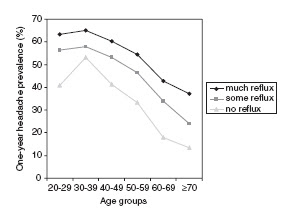 A large study conducted in Norway points at some definite links between headaches and GI tract complaints like acid reflux (see figure on the left), nausea, constipation, and diarrhea. Over 60,000 people participated, and the results were adjusted for sex, age, education, depression, anxiety and use of medication. The clearest connection was between headache frequency and GI symptoms (rather than severity, or simple headache occurrence). All reported symptoms were evaluated clinically (quite a feat!) and so there is some measure of objectivity to the data as well.
Stress, inflammation, and chronic disease
 Sure, we all know that stress, tension and the anger that sometimes accompany them don't make us feel too good. A study from researchers at Duke, using data obtained by the Air Force, reveals just how linked these aspects of life are to crucial markers of cardiovascular inflammation. Elements (part of the complement family of proteins) in the blood that are involved in regulating inflammation in the heart and blood vessels seem to get overproduced by significant factors in men who feel more anger, hostility, and depression.
Subscribe to:
Posts (Atom)