Numen: The Healing Power of Plants
Let's face it, herbalists are lucky. We get to interact with plants and people in a very special way, one that emphasizes an age-old evolutionary connection between the two. This was recently brought home to me, yet again, sitting in circle with a group of herbalists, on a warm October day, after harvesting a bunch of excellent roots. We spent time giving thanks to the land, to the plants, and to the gatherers' hands. We spent time just participating in a moment of deep animal-vegetable relationship, one which humans must have experienced over and over again in the course of our long journey.
Three simple medicines for winter health
Consider these quick, easy preparations to add to your pantry as the season gets colder. They are based on three general ideas in herbal therapeutics: tonify immunity using botanicals that interface with our innate immune systems via gut-associated lymphatic tissue; improve circulation and load the bloodstream with pungent, volatile, antiseptic substances that escape through the respiratory tract; and reduce inflammation while encouraging perspiration to relieve symptoms of congestion and fever.
Nike! An equinox exploration on psychedelics, running, and victory

In the story of the battle of Marathon it's rumored that, after running back to Athens following his people's brutal battle with the Persians, Pheidippides uttered a single word - nike!, which means victory - before collapsing dead from exhaustion. He most likely meant to convey news of victory in battle, but he may have meant it for himself, too: despite his unfortunate end, there must have been a moment of deep joy and satisfaction once he actually made it home.
An herb walk through the high Alps
I've been away from technology for a few weeks. Wandering the Alps, valleys where I grew up, in deep old forests carpeted with wild bilberries and up above the treeline in full view of the Dolomites. I've walked some really well-worn paths, visiting with the plants along the way and thinking about consciousness, presence, perception. These mountains are us - or, at the very least, I can feel the boundaries of my consciousness bleed into the the rocks and forests, the trail becoming more than a footpath, the walk becoming a habit the whole ecology has practiced for a long, long time. Do you know what I mean? Mountain telepathy, Euphrasia mind-meld, or really just finally resting in the place where "I" really feels like a composite of everything here.


Herb Power: find your wild ally this summer
Recently, scientists uncovered the remains of a Neanderthal tribe that lived in the area now known as Spain, some 50,000 years ago. Analyzing residue on their teeth, the researchers discovered traces of powerful chemicals: triterpenes and lactones from chamomile and yarrow were still detectable, and indicated that these early hominids consumed these plants, which have little or no caloric value. It’s an intriguing finding: have we been harnessing the power of herbs for that long?
A plant perspective on the herbalist work
 In my dream last night, I was walking with an old friend. We were making our way through overgrown meadows, along a stream that drained a big pond. A thicket of small trees and sumac came up on the left, and my friend walked in, all of a sudden very excited. He called to me to follow. He was looking for a plant he'd seen there, one he wanted to show me, one he was thrilled to have found. In that state of semi-lucidity so often encountered in dreams, I though to myself "ooh, a plant dream. This is going to be good." I got a little excited too. He pulled some brush aside, and there, in moist rich soil a few feet from the stream, was a tiny burdock plant. I remember looking at him like "you've got to be kidding me."
He proceeded to tell me all about how he'd been waiting so long for burdock to return to this land, how wonderful and special a plant it is, how it digs deep magic out of the hardest places, how it brings just the right kind of moisture to the skin. I wasn't too impressed, but I indulged him - after all, he was an old friend I hadn't seen in a long, long time, and he was apparently talking about an old friend of his that he hadn't seen in a long, long time either...
Old skills and gratitude
In the hills north of Montpelier, Vermont a small group of folks (some of them are herbalists too, studying at our school) are teaching skills humans have possessed for a long, long time. The Roots School instructors have been mastering tracking, tool-making, weapon-crafting, fire-summoning, fiber-spinning, hide-tanning and more...

Many people are interested in these traditional approaches to meet the basic needs of life. Why is this? Does learning this stuff have any inherent value?

Many people are interested in these traditional approaches to meet the basic needs of life. Why is this? Does learning this stuff have any inherent value?
Excerpts from Carmina Gadelica
Around the turn of the 20th century, Alexander Carmichael collected poems, hymns and incantations from the Scottish highlands into a six-volume compendium that includes both (extensive) Christian and Pagan verses. The digitized edition of Volume II includes a number of gems, with facing text in the original Gaelic. Here are some excerpts:
Kevin Spelman - molecular bio of immunomodulators
From the AHG symposium
 |
| Kevin Spelman |
Cytokines and the cytokine theory of disease (Czura, CJ 2005): overproduction of cytokines can cause the clinical manifestations of disease. But it can begin on an emotional level (anger/shame as opposed to medidative states) - then as cytokines levels increase, disease manifests: first depression, pain, anorexia. Then, psoriasis, colitis. Then, tissue damage and arthritis. Finally, shock and organ failure.
Tumor necrosis factor (TNF) and other cytokines like Epidermal Growth Factor stimulate a series of intracellular changes that ultimately have effects in the nucleus - on genetic expression. When, in researching botanicals, we look at the nucleus, we're getting somewhere.
Lisa Ganora - synergy in botanical medicines
From the AHG Symposium
 |
| Lisa Ganora - synergy in botanical medicines |
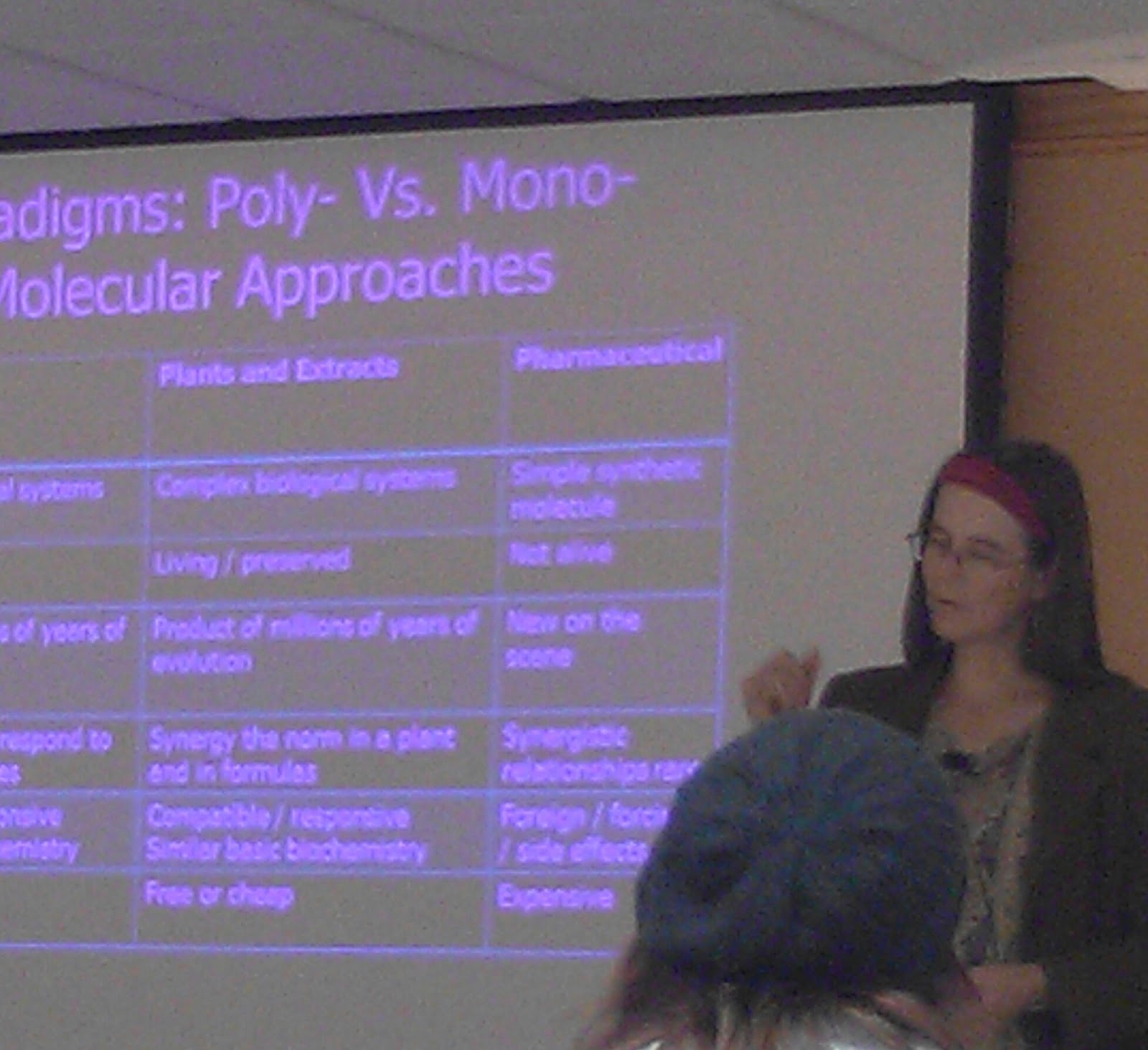
Polymolecular approaches, which rely on synergy, have a unique ability to interface with the complex biological system of the human being. Plants provide this. Huge difference compared to pharmaceutical agents. Additionally, pharmaceuticals are very new on the scene. And most aren't cheap (whereas plants...)
The need for long-term thinking in medicine: Cinnamon as a case study

Urban Moonshine herbal conference report

Aromatic plants – cultivating the scented garden within
 It is legend that, some twenty-five hundred years ago, a ruler of Babylon (or was it Niniveh?) commissioned a wondrous garden, terraced up from the flat plains between the rivers of the Fertile Crescent. Its levels were built of huge slabs of stone, elaborately carved and supported by high vaulted colonnades. Huge amounts of soil were transported to create hills and fields in this garden many, many feet above street level. Sundry species of trees, shrubs, flowers and herbs were brought in to plant its winding paths. Using giant corkscrew pumps, thousands of gallons of water were moved against gravity on a daily basis to keep the garden lush and green. The ancient historians named it one of the seven wonders of the world, and marveled at this oasis, high above the incessant bustle of the city, smoothed with endless marble and steeped in a deep, seductive fragrance from the constant bloom of aromatic plants.
The Natural Products Industry that Isn’t
A few evenings ago I was sitting on a rough cedar deck, watching sunlight orange across the tops of the poplar and maple canopy, and thinking how nice it was to be visiting my friend’s house in the forest: the nestled feeling, the total privacy, the familiar smells. He confessed that, sometimes, he too liked to imagine his house from the perspective of a guest, walking through his gardens, up the wooden steps, and into the kitchen with the eye of an outsider, taking the time to appreciate it without the preconceptions and perceptual habits that develop after living in a place for an extended period of time. Perhaps it was the effects of the mixture of Schisandra kombucha, gin, and tonic water we were drinking, but this short exercise in mindfulness seemed to me as both a useful habit to practice and also a profoundly important skill for the modern human. We are so entrenched in our politics, our communities, our niches and worldviews that, without occasionally looking at life from outside the fences, we might run the risk of missing out on an important and useful perspective.
A brief and practical introduction to pulse and tongue assessment
Any assessment or diagnostic technique that seeks to make sense of what’s happening inside the human system is inherently pretty complex – be it a modern tool such as a CT scanner, or a traditional device such as the stethoscope. Interpretation is tricky, and the background knowledge required can often be intimidating. While using the tongue and pulse to get a glimpse inside the human body is not an exception, one can nevertheless glean really useful, actionable information with even a basic understanding of the technique. This basic understanding can become richer and deeper with ongoing practice. The complexity evidenced in traditional texts on the subject should not be a reason to keep you from experimenting!
Plant allies for winter health
Enhancing immune activity
Why: Herbal allies to combat respiratory infection as it begins.
Echinacea, Andrographis, Elderberry, Hyssop, Garlic, Osha
These agents provide an immediate “boost” to immune function, particularly the body’s ability to produce antibodies against viral infections. Will shorten the duration of common winter infections, and can also be used longer-term as preventative agents particularly for those more at risk.
Plant medicine heals more than just people
 We often discuss how effective plants can be at supporting and gently bringing human beings back to a state of "wellness" (meaning that resiliency, vibrancy, passion are maximized). I've spent a lot of time exploring how this happens, reading through the historical record and perusing modern research, and on balance it seems pretty clear that medicinal herbs, trees, mushrooms and more are good at helping folks in need. But that's not what I want to discuss today.
Joyful herbs for the darker days
All of us feel the loss of daylight to a certain extent. For some, it may be occasional sluggishness, less motivation to get outside and exercise, or less of a desire to spend time with friends and family. Others may feel even deeper withdrawal, or experience less control over anxiety and the sometimes overwhelming responsibilities of daily life. To a certain extent, the culture has tried to address this by consistently packing in times of remembrance, celebration, and family during the darkest months of the year – but by the time it’s all over (or even during the often stressful holidays), there are still many months of darker days left and it is usually at this time that folks express the desire for more fun, more joy, more light.
The bitter flavor and the bitter herbs - trust and embrace
The opportunity recently to spend some time talking with Jovial, whom I've known for a while but who recently started the excellent herbal bitters company Urban Moonshine. The focus was often on the bitter extracts themselves (the tincture blend she makes is actually pretty tasty and mellow compared to some of the wormwood / artichoke / mahonia combinations I've made up for clients in the past), but we ranged off into more philosophical realms pretty quickly.


Subscribe to:
Posts (Atom)